|
THE JOURNEY PROGRAM
|
 
 |
|
|
The Journey Program Summary
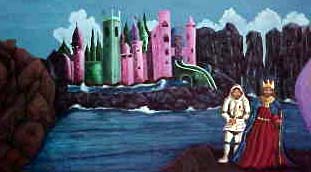 "Camelot" "Camelot" |
|
Children play The Journey game by hiking to each
of The Journey's nine
adventures. |
The Journey is a fun,
innovative adventure game and a corresponding Mythological
story that parents, teachers, therapists, and a direct care
staff can use to teach children skills and values that may
prove to be helpful in the "game of life".
The Journey relies upon
storytelling, artwork, and behavioral therapy to develop a
child's self-respect, relationship skills, self-discipline,
and altruism.
Uniquely, The Journey also provides training in
"extraordinary world" skills such as the use of one's
intuition, finding magical moments in daily life, and how to
be of service to others.
Children play The Journey game
by hiking to each of The Journey's nine adventures. Children
hike or move toward the next adventure by following "the Rules
of the Hike". A map illustrating the nine adventures and each
child's progress on The Journey is depicted on the walls of a
room.
The Rules of the Hike require children:
1. To follow the rules
2. To cooperate with
requests
3. To participate in their daily assignments
When children follow The
Rules of the Hike, they take a step per day toward the next
adventure. Once children arrive at the next adventure, they
receive training in a skill building group and they are
assigned goals or tasks which utilize these
skills.
Upon completion of that adventure's tasks,
children earn that adventure's designated rewards. At each
adventure, children can earn rewards such as privileges, small
items or positions of recognition.
GUIDES:
As children play the journey game, their
parents, teachers, therapists or caregivers serve as "guides"
for the children. Guides provide the training, encouragement,
and coaching necessary to successfully play The
Journey.
 "As children play The Journey,
they are taught that problems are merely challenges in
disguise." "As children play The Journey,
they are taught that problems are merely challenges in
disguise." |
|
In addition to playing The
Journey Game, children read the story of The
Journey. | In addition to playing
The Journey Game, children and their guides read the story of
The Journey. The Journey story relies upon myths and legendary
characters to explore values such as avoiding revenge,
avoiding prejudice, developing a work ethic, and the
importance of being of service.
As children and guides
read The Journey together they discuss beliefs such as:
kindness is strength, an appreciation of differences, and that
we are more alike than different.
The Journey Story has
nine chapters that correspond to the nine adventures of the
game. As children read The Journey, they are presented with
curriculum that includes discussion points, vocabulary, art
projects, small group activities, and games.
The
Journey is helpful to parents, teachers, and direct care staff
in that power struggles between children and authority figures
can be redirected to the problems a child is having meeting
the challenges of the game. In other words, a child's problems
are reframed as being the result of their difficulty following
the rules of the game.
The 3
Objectives of The Journey Training

1. Will gain
a working knowledge of how to use The Journey game to
create a safe environment and promote achievement
through the use of behavioral therapy.
2. Will
gain a working knowledge of how to use The Journey Story
as a format for discovering values and developing
beliefs such as; appreciation of differences, avoiding
revenge, and work ethics.
3. Will gain a working
knowledge of how to be a guide for children and provide
training in daily life skills such as self-respect,
relationships, self-discipline, leadership, and being of
service to others.
|
|
|
|
|
|
|
|
|
|
The Journey's Five Functions
|
|
|
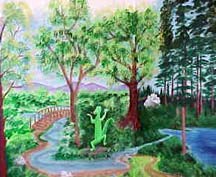
Having crossed the river on
an old wooden bridge, Talon and Longin found
ferns, moss covered rocks, and a curious green
lizard...
The Journey game uses artwork, rewards, and
consequences to motivate
children. | I. THE JOURNEY
GAME:
The Journey
is a fun adventure game that serves as a behavior
management program and a skills building program.
The Journey game
uses artwork, rewards, and consequences to motivate
children to:
1. Follow the
rules
2. Cooperate with requests
3. Participate
in their daily assignments
As children play The
Journey game, they move forward on a map, which is
illustrated on the four walls of a room.
The Journey map depicts each child's
progress and the nine adventures they will experience as
they play The Journey game.
II. THE JOURNEY
STORY:
|
|
|
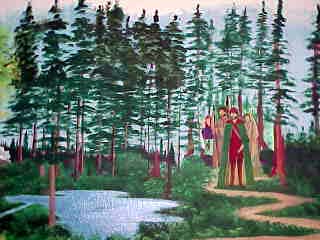
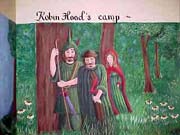
Robin hood paused and smiled,
"This then is the story of the Crimson Dragon. May
it serve you well."
"Without question, Talon knew this must be
the feared Robin Hood and his band of
thieves" | The Journey story
relies upon storytelling, myths, and legendary
characters to explore important values such
as
developing a work ethic, avoiding revenge, and the use of
nonviolent conflict
resolution.
III. THE
JOURNEY'S SKILL BUILDING
GROUPS:
The Journey Groups provide children with
training in...
1. Basic Skills such as
self-respect, relationship skills, self-discipline, and
assertiveness.
2. Intermediate skills such as
leadership, teamwork, being of service, and task
persistence.
3. Advanced skills such as
relaxation training, dream work, the use of intuition,
thankfulness, and creative
self-expression.
IV. THE JOURNEY DISCIPLINE
PROGRAM:
The Journey
Discipline program provides guides with:
1.
Strategies for preventing behavioral
problems.
2.Stategies for reframing and redirecting
children with behavioral problems. Suggestions for
intensive supervision such as time-out procedures,
in-school suspension, or in-shelter
suspension.
V. THE JOURNEY
CURRICULUM:
The Journey
Curriculum provides teachers with lesson plans at each
chapter of the story including:
1. Discussion
points
2. Vocabulary words
3. An art project
4.
A small group activity
5. A game to
play
|
|
|
|
|
|
|
|
|
|
|
|
|
| | |