|
|
 |
 |
|
|

PROGRAMS:
SCHOOLS
In my role, as a school psychologist, I saw despair
in the public schools. Often, the students and teachers seemed
demoralized by a lack of funding and academic
failure.
In particular, the special services' classrooms carried
the burden of social rejection and the stigma of "special
education."
In these classrooms, students responded to their
feelings of hopelessness and failure by becoming either the
class clown or the invisible student. For these students, it
was better appear "unwilling" to learn rather than being seen
as "unable" to learn.
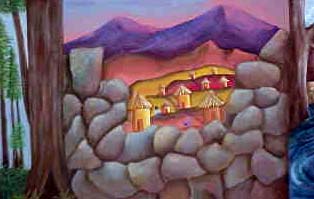 "The Lost Village" "The Lost Village" |
|
Mastery experiences require a child
to plan, persevere, and to believe in their own
skills. | Morita Therapy
Morita therapy was
developed in the early 1900's in Japan. Morita teaches
children to take action and develop the skills necessary to
"climb" the obstacles in their life.
Often these obstacles
stand between children and the realization of their goals.
Morita proposes that once children have developed the life
skills necessary to climb one "mountain" in their life, they
are prepared to use these same skills to climb future
"mountains."
The Journey hopes to provide the footholds
necessary to climb these mountains.
Mastery Experiences
When a child takes
action and utilizes the skills necessary to surmount a
challenge and to reach a goal, the result is referred to as a
mastery experience.
Mastery experiences require a child to
plan, persevere, and to believe in their own skills. In other
words, mastery experiences teach children that through hard
work they can make their dreams come true.
The Journey was designed
to increase the frequency of cauldrons mastery experiences by
teaching them ego skills. Ego skills include: 1) task persistence, 2)
frustration tolerance, 3) mood modulation, 4) impulse control,
and 5) delayed gratification. Ego skills are the tools that
are necessary for children to reach their
goals.
Ego skills lead to self-discipline and "do not drop
from the heavens as does the rain and snow". Rather, ego
skills have to be taught to a child by a caregiver. Many of
the children who experience academic failure need to be taught
ego skills.
Locus of Control
The nine Journey
adventures present children with challenges or goals which
must be mastered in order to earn the adventures'
rewards.
Over time, these mastery experiences can lead to the
development of an internal locus of control. An internal locus
of control is the belief that through one's effort and hard
work one determines whether one succeeds or fails.
Importantly, an internal locus of control has been shown to be
related to increased motivation, academic achievement, and a
reduction of feelings such as helplessness and
hopelessness.
On the other hand, a person with an
external locus of control views success or failure as the
result of luck, the behavior of others, or the self-perception
that one is inherently good or bad.
Children who have an
external locus of control do not perceive themselves as the
casual agent for their success or failure. For example,
children who have a "victim script" have an external locus of
control. They believe that whether they succeed or fail has
been determined by their abuse or failure experiences.
A
clear goal of The Journey is for children to develop an
internal locus of control. When children have an internal
locus of control, and they have not experienced success, they
view their lack of success as the result of either 1) having
an inadequate plan or 2) not having "worked long enough" to
achieve success.
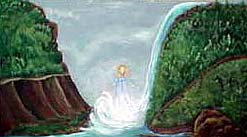 "Angel of the
Waterfall" "Angel of the
Waterfall" |
|
The Journey addresses spiritual
awareness in the form of Being of Service to others and
in the sense of exploring our connection to others...
The Journey was designed for children of any faith and
for children who do not have a faith or religious
belief. | Personal
Growth
While The Journey
initially focuses upon teaching children basic and
intermediate skills; the Journey also recognizes that these
skills are necessary but not sufficient for personal growth
and "artful living."
Personal growth requires that in addition
to these skills, children develop their intuition,
imagination, mindfulness, and wisdom.
The Journey's sequence
of training is similar to Abraham Maslow's Theory of
Humanistic Psychology.
Maslow states that human beings
have a hierarchy of needs and that a person must satisfy their
basic needs for physiological survival, safety, and belonging
before they can truly focus upon meeting their higher needs
for self-esteem and self-actualizing
experiences.
Much like Maslow's hierarchy of needs, The
Journey's hierarchy of skill building moves from teaching
basic life skills such as: self respect, relationships,
assertiveness, and self-discipline; to teaching intermediate
Life Skills including: teamwork, leadership, and respect for
nature. Once a child has mastered the basic and intermediate
skills, they are prepared for training in advanced Life Skills
such as intuition, thankfulness, creative self expression, and
Being of Service.
|
|
|
| | |